Introduction
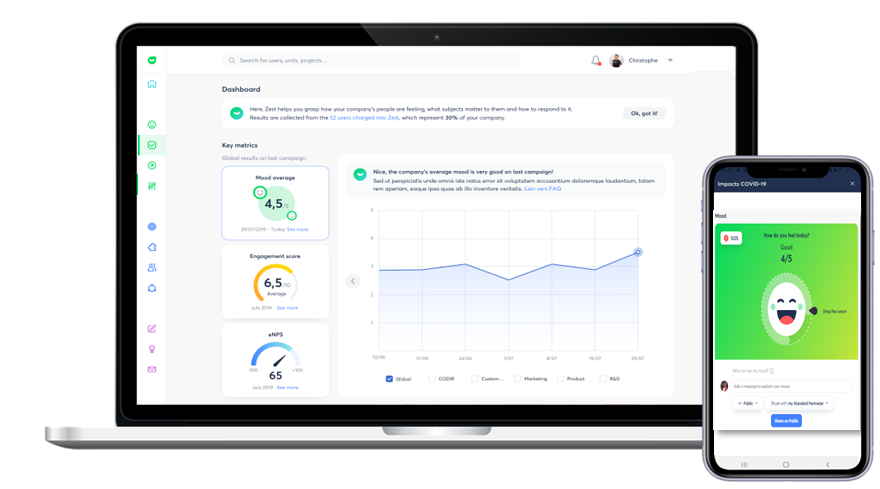
In order to be able to recommend an action plan for the Mood function, we first need to target your issue. Below you'll find a number of possible scenarios.
Issue n°1 : Low moods
Before jumping to conclusions, we need to ask ourselves a few questions:
- How often do these low moods occur?
- Do they affect a specific area? Or are they spread throughout the company?
- Are you going through a particular situation? Is the social climate tense?
- Have you detected a problem in terms of managerial relations?
- Are the low moods shared by isolated employees or those working remotely?
Issue n°2 : SOS
SOS messages indicate that someone is in distress. When an employee clicks on the SOS button, they are asked to specify the reason for the urgency from among the following suggestions: burn out, ethical problem, discrimination, harassment, incivility. In the event of an SOS, we invite you to react quickly by contacting the employee directly.
If these SOS recur frequently (several times a month), we need to ask a few questions:
- What is the scope concerned?
- What are the managerial relations?
- Is there a workload issue?
- What are relations with colleagues like? The social climate?
- What is the company culture when someone is not doing well? Is there anything you could do to improve your reflexes?
Issue n°3 : Low participation (<20%)
Low participation is defined as less than 20%: this means that less than 20% of your employees share their mood once a month. There may be several reasons for this:
- Have you activated automation? If so, how often (hour/day/period)?
If employees are not solicited, they will not necessarily have the reflex to connect to Zest to share their mood.
- Do you have any current surveys containing mood-type questions?
If so, beware of the risk of redundancy: employees may not see the point of sharing their mood if they have already taken part in the survey.
- Have employees been informed about the usefulness of the feature?
Whatever the feature concerned, communication is key to encouraging buy-in.
- Have you included mood in your daily practices?
The more the feature is part of your rituals, the higher the take-up will be 🙂
- What are your managerial relations like? Do you think you have a climate of psychological safety in your company?
Employees may not dare share their moods for fear of reprisals.
- Do your employees have the opportunity to see their colleagues' moods and comment on them?
If not, the social cohesion dimension is lost. Having visibility of other people's moods can also inspire some of them.
⛑ Our recommendations for action
📚 Resources
💡To find out more, all our best practices: the Adoption Guide to get the most out of Zest!
→ For example, regarding low moods, ask questions like: Do you feel free to communicate within your team? etc.
Reco n°2: Set an example as a manager/admin, encourage participation (likes, comments), set visibility to a minimum on the team, be reactive in the event of a low mood and contact the person directly (if not anonymous) or provide a comment.
Reco n°3: Launch a mood challenge: the team with the best participation rate wins a reward (encourages employees to go on the mood).
Reco n°4: If no automation or too infrequent, activate it or increase the frequency.
Reco n°5: Include mood in daily practices (events, weekly meetings) and consider it as a KPI in its own right.